Professor Kathryn McNeilly was conferred to the Fellowship of the Academy in autumn 2026. She is Professor of Law at Queen’s University Belfast.
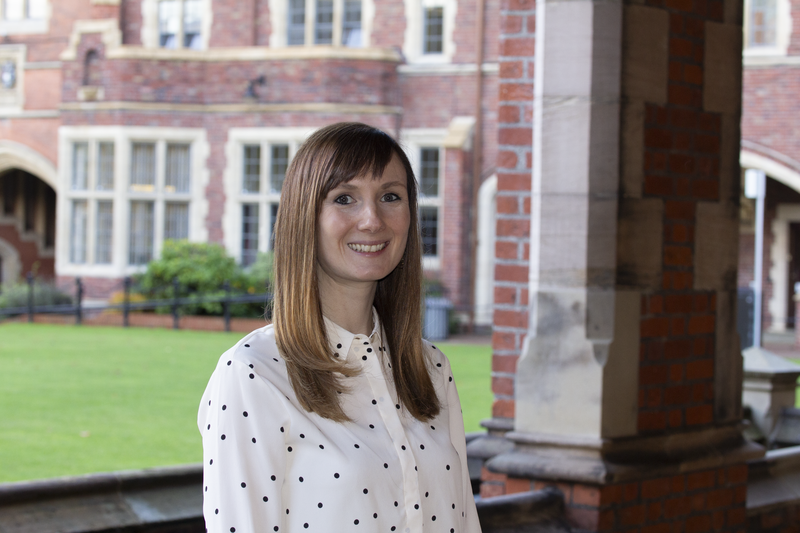
Professor Kathryn McNeillyFAcSS
A leading scholar in international human rights law, Kathryn’s research cuts across the theory and practice of human rights, offering new ways to examine contemporary legal questions.
Kathryn has been at the forefront of developing a significant new line of scholarship on time and international human rights law. This work has deepened understandings of the significant, and often taken for granted, role that time plays in law’s development and operation. She has revealed time to be a thread weaving across legal norms and bodies, and a key part of how lawyers and others engage with human rights.
This research has been supported by the Leverhulme Trust and the UK Socio-Legal Studies Association. Drawing on her expertise in the area, Kathryn is the lead editor of the landmark collection The Times and Temporalities of International Human Rights Law (Hart, 2022), the first book examining this subset of law through the lens of time.
Kathryn is an Editorial Board member of the leading international journal Human Rights Law Review and co-convenor of the Socio-Legal Studies Association’s Equality and Human Rights Law stream. In these roles she works collaboratively to support emerging research in the field. She is also a member of the Royal Irish Academy’s multidisciplinary Ethical, Political, Legal and Philosophical Studies Committee.
Why do the social sciences matter?
The social sciences are a lens through which we can gain useful understandings of society and how it functions. From these understandings, new routes to further support or enhance society, its organisation, and policy related to it can emerge. This is particularly significant against the backdrop of current developments in areas like technology and communication, population, the economy, and health which require reflective, and creative, responses.
As a lawyer, the social sciences matter because they help to locate law in the wider context in which it is created and operates. This is important to stimulate a full picture of law, including norms such as human rights. Innovative approaches to legal scholarship can follow from this use of the social sciences toolbox.
What do you enjoy the most about your work?
I enjoy the ability to develop collaborative links to explore contemporary issues. This requires drawing on differing forms of expertise as necessary and can help to stimulate creativity in research. Collaborative partnerships can span work with academics from law and wider disciplines, as well as engagement with lawyers and other professionals. The ability to create and add to these collaborations in a flexible way is important in tackling research challenges.
I very much enjoy the global nature that research collaborations often take, linking with colleagues across the world on common interests and questions. This can produce fruitful insights and, as an international human rights lawyer, is core to the work that I do. Through working in this manner, I have learned more about different ways to understand law, to give meaning to human rights, and to approach research overall.
What is the most urgent issue social scientists must tackle today?
Surveying the social environment today, pressing challenges are evident. These relate to the economy, climate, and emerging technologies, among other issues. Some of these challenges are taking the form of crises unfolding in a rapid manner. The social sciences must be at the forefront of grappling with these complex topics and doing so in a way that can help offer timely responses to them. This requires joined-up working across disciplines and an approach that spans academia, policy, and other domains.
Related to this, social scientists must remain agile to respond to new crises as they emerge. Frameworks for working should ensure that research is responsive, horizon-scanning, and able to keep pace and offer reflections that are able to support society as it changes or evolves.
What does being a Fellow of the Academy of Social Sciences mean to you?
I am honoured to join such an esteemed and diverse community of academics and practitioners. Becoming a Fellow of the Academy has offered the opportunity to reflect on my research to date. From this reflection I can see the insights that would not have been possible without engagement with social sciences approaches. I view Fellowship of the Academy as both recognition of, and another step in, my work to further advance understandings of law and explore its operation as part of the social world.