“Social science is not just a discipline. It’s a way of seeing the world, of asking the questions that matter, of understanding the forces that shape health, wellbeing and justice. Without it, science risks becoming detached from society. With it, we have a chance to build systems that work for people, not just in theory but in practice.”
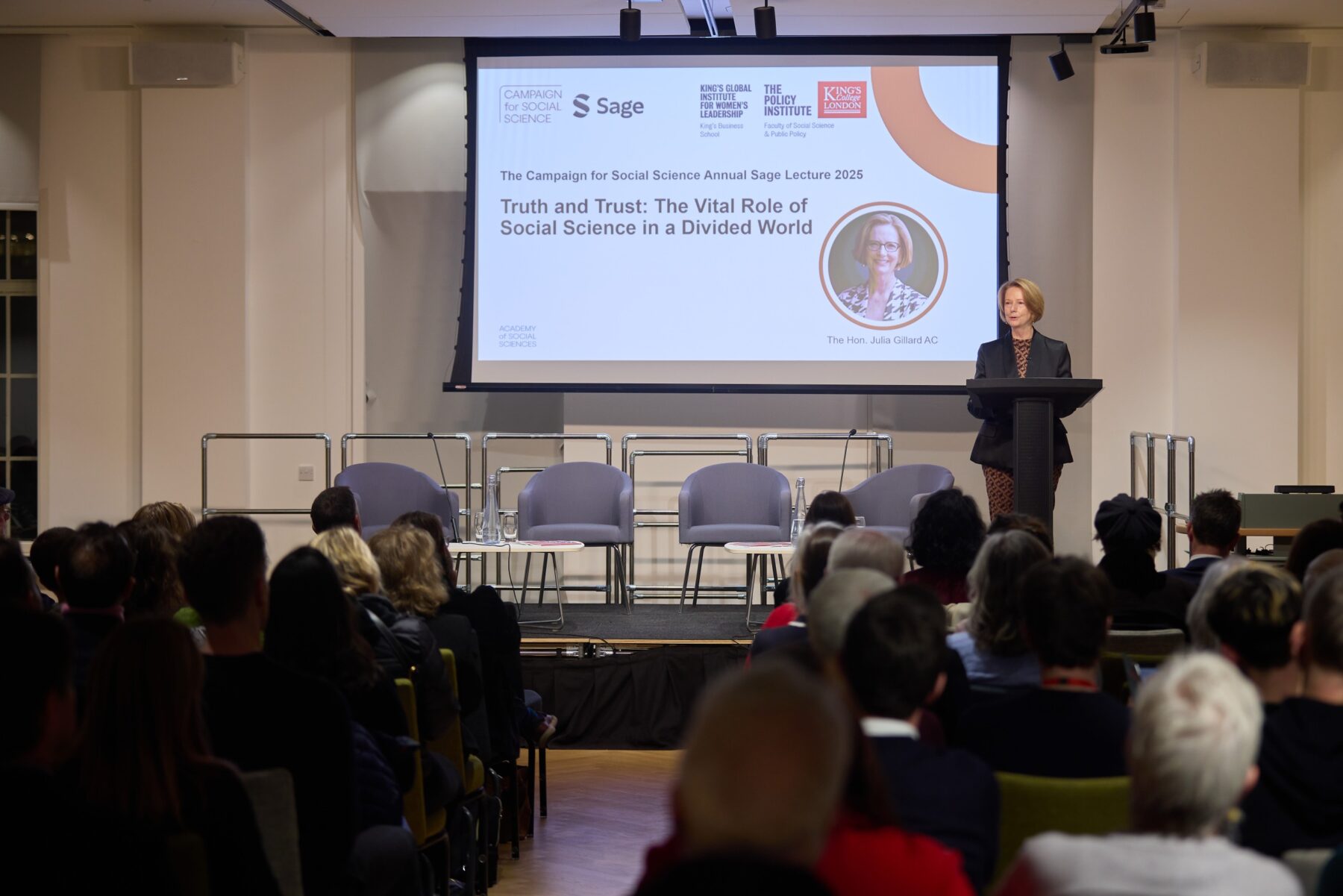
Last week we were delighted to welcome the Honourable Julia Gillard AC, 27th Prime Minister of Australia and Chair of the Global Institute for Women’s Leadership at King’s College London, to give this year’s Campaign for Social Science Annual Sage Lecture focusing on the role of social science in a divided world.
Following a welcome from Professor Bobby Duffy FAcSS, Chair of the Campaign for Social Science, Julia began her lecture by reflecting on some of the recent work of the Academy and Campaign in championing the vital role of the social sciences for public benefit. She highlighted how in a world defined by accelerating change, we need a deep, nuanced data driven understanding of people, society and place, which the social sciences are crucial to provide. Julia then touched on some of the risks to the social sciences, both in the UK and internationally, including the pressures of reduced or restricted university funding and increasingly politicised and polarised views on what is and isn’t important to focus research efforts on.
She said, “Additional layers of challenge come from the funding constraints facing universities here and in many other parts of the world. We see a trend towards vocational courses and degrees that promise a direct line to employment, even though in a world of AI driven labour market change, such promises aren’t golden. In research funding there’s a growing emphasis on what’s profitable, what’s patentable, what’s measurable in quarterly returns. So, the threats are ideological and fiscal.”
Julia further explored the public’s perception of research and development and universities themselves, drawing on research funded by Wellcome, and what this could mean for the social sciences. She pointed out that of those surveyed, initial associations with research and development (R&D) focused on consumer technologies and medical advances rather than the arts or humanities. The findings also highlighted that R&D was seen to be most associated with the private sector as opposed to universities, and that stereotypes persisted around academic researchers. But there was a recognition that R&D delivered benefits with 71% of those surveyed agreeing that the government should maintain or increase levels of R&D funding. Although there were significant differences between views on the benefits of R&D to people’s lives when voting intentions were taken into account, with Labour and Conservative voters tending to be more supportive of R&D compared with those intending to vote Reform.
Julia said, “We have work to do to explain the benefits of research, and especially of the social sciences, the contribution of which is even less understood than research generally.”
Julia then drew on a recent Global Institute for Women’s Leadership report, in partnership with Ipsos, exploring attitudes to gender equality, where 44% of participants agreed that gender equality has gone so far that it now discriminates against men. She pointed out that there are differences among generations with these views, with men in older age brackets being more supportive of gender equality than those aged 18-27. Julia then went onto explore the factors that could lead to this shaping of attitudes in young men, from social media to political rhetoric, pointing out how social science research has a role to play. She highlighted research from the Global Institute for Women’s Leadership which has created a UK Gender Equality Index to further understand gender equality within communities.
She said, “We have failed to explain that a gender equal world will be a better world for everyone. We have allowed the impression to settle that gender equality is about benefits for women, not benefits for all. Yet we know that men also benefit from living in more gender equal communities.”
Following this Julia pointed out some positive examples of where social science research, funded by Wellcome, is making a difference to people’s lives and communities around the world. One of these is Care-full Synthesis, a social science programme running alongside the Synthetic Human Genome project, which explores the social, political and cultural questions raised through the synthesis of human genomes, including what does it mean to build human DNA, who gets to decide how it is used and how to ensure this technology serves the public good.
Julia said, “Care-full Synthesis is setting the standard for responsible innovation, one that puts social science at the heart of scientific progress. It’s not just observing from the shore, it’s helping steer the ship.”
Julia went on to explain the funding opportunities that Wellcome are providing to support social science research and innovation for the benefit of all. She ended with a call for a feeling of urgency to address the very real and pressing challenges society faces but also hope for the ability to learn from our mistakes and the power of research to advance humanity.
She said, “Social science isn’t just about health. It’s helping us understand the dynamics that shape equality, leadership and opportunity. If we want to build a fairer, more inclusive society, we need to understand it first. That’s the power of social science.”
Following Julia’s lecture, Stian Westlake, Executive Chair of the Economic and Social Research Council, and Yuan Yang, MP for Earley and Woodley, provided their reflections on the role of social science in an increasingly divided world.
In his reflections, Stian summarised ESRC’s formation and how social science is a truth-seeking endeavour which seeks to make the world better but also raised the point that social scientists are themselves part of our increasingly divided world. As such he posed the question of how social scientists, as participants within society and also being part of the divisions that go on, can underpin their role as truth-seekers in a politically diverse society.
Following this, Yuan outlined how social science factors into the framing of policy decisions not just in terms of outcomes but also by the questions that are being asked in the first place. She also commented on how the speed at which results from social science research are collected is out of sync with the political cycle and used the example of Sure Start centres to illustrate this. She ended by asking how those in academia and government can engage and connect better with the people whose lives they are seeking to improve.
The full lecture is available to watch in the recording below.
Photo courtesy of James Robinson Photography.