Summary: How can the social sciences play an active role in the new Scottish Government’s agenda?

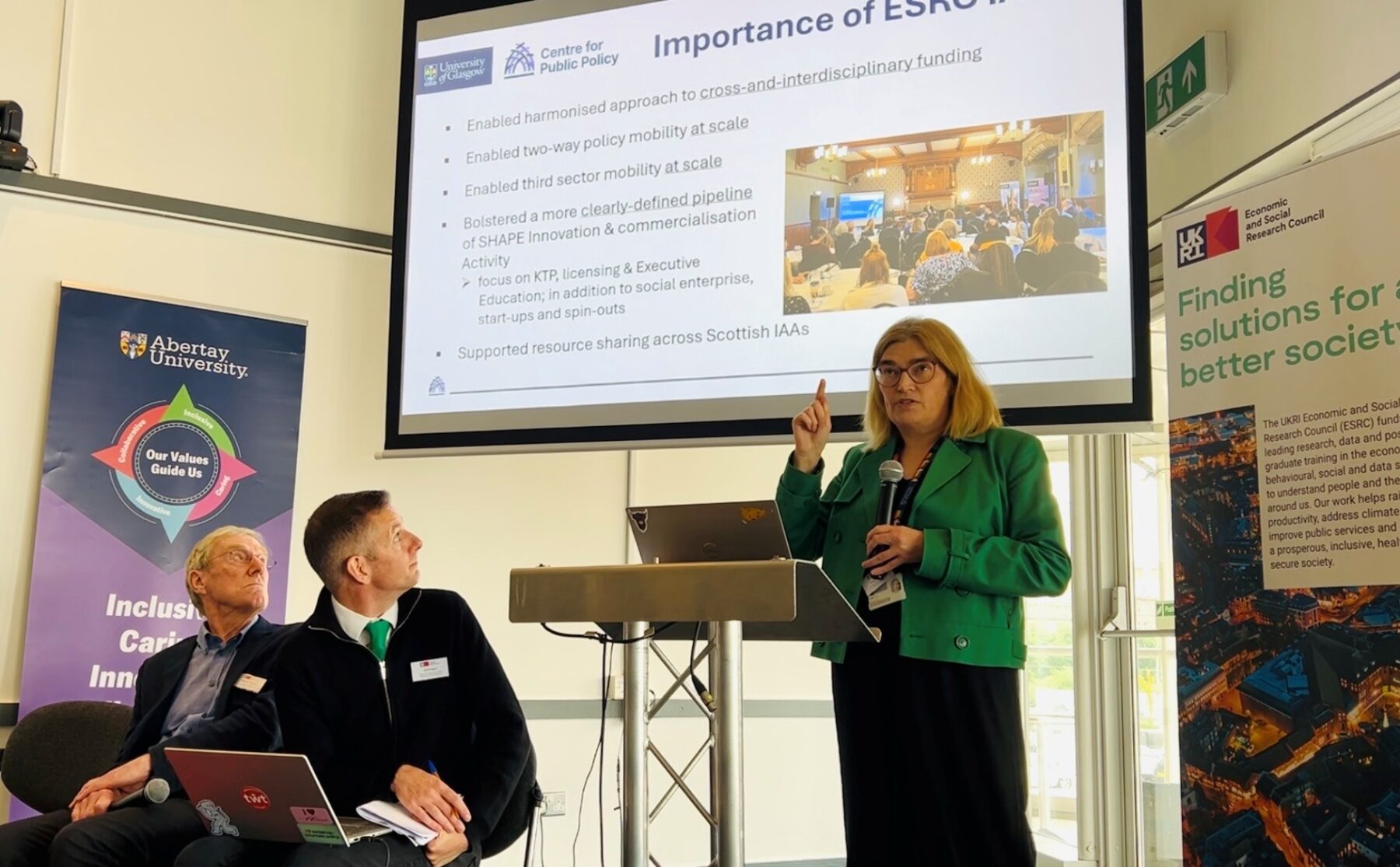
As part of the Campaign for Social Science’s series on devolution, we were delighted to host a panel session in Dundee as part of a regional showcase event run by the Economic & Social Research Council on 16 June 2026. Our session explored how, following the recent Holyrood elections, the social sciences might play an active role in the new Scottish Government’s agenda. It was chaired by our Head of Policy and Public Affairs, Dr Ed Bridges and featured contributions from Professor Nicola McEwen FAcSS and Professor Michael Keating FAcSS.

Below is a summary of their remarks.

Nicola, who is Director of the Centre for Public Policy at the University of Glasgow, began by reminding the audience of the Scottish Government’s revised national performance framework, and the outcomes framework in the SNP manifesto, that is likely to shape the Scottish Government’s programme for government. Nicola argued that these outcomes are very broad, and centre on what the SNP in government hopes to achieve, but as yet there is little detail on how outcomes will be reached.

Nicola suggested that this creates a considerable opportunity for the social sciences to inform debate and policy development, both with research evidence and analytical approaches that can help to drive system change. She argued that social scientists can help government to identify the barriers in the way of change, as well as the policy and institutional interventions that can support government and others to overcome those barriers. She suggested that maximising the opportunities for social science to have societal impact in this new session of the Scottish Parliament will benefit enormously from research council investment that recognises the time involved in building relationships and driving change.

Finally, Nicola posited that the social sciences are well-placed to both help and to challenge the Scottish Government to think beyond narrow electoral cycles, by drawing attention to challenges such as changing demographics, declining trust in politics, or climate change, that are storing up longer-term challenges that future governments will have to confront.

We then heard from Michael, who was a Founding Director of the Centre on Constitutional Change, and is now Emeritus Professor of Politics at the University of Aberdeen. He started by reflecting on the Scottish Parliament’s reserved (rather than conferred) model of devolution, which theoretically should allow it to push the boundaries of what is possible in terms of policy – but Michael argued that the reality has been much more cautious, with the Scottish Government heavily resembling the structure of the UK Government, and acting as “an extension in many ways of the Scottish Office”. Michael therefore ascribed the Scottish Government’s flaws not to a lack of competence but to a lack of confidence, combined with an imperfect financial settlement based upon a tax system (at both a Scottish and UK level) which is “neither socially progressive nor economically efficient”.

Michael then set out that the other key constraint upon Scottish Government is a political one, of wanting to shy away from decisions or policies which could potentially be unpopular:

Michael also explored the policymaking process within Scotland and the lack of capacity and mechanisms to draw effectively on research (both from and beyond the social sciences), noting that the Centre for Public Policy is helping to overcome some of this. He particularly explored the ‘consultation gap’ whereby researchers are deluged by consultations and inquiries to which they might contribute, but not all of those opportunities are necessarily meaningful. Some researchers are able to circumvent this by having good enough connections to policy that they can speak to the right people in government – but this is not true across the board, even within the social sciences.

Two significant insights from the session were:

  • Collaboration will be key to the new Scottish Government’s agenda. Their new outcomes framework (when it gets defined) will likely have partnership working and co-production at its heart. Social scientists will play a critical role in ensuring that such partnerships are meaningful, draw on the best-placed voices, and are evaluated properly for what they deliver.
  • This parliamentary term could – and maybe should – see the Scottish Government be bolder in its policy platform, making the most of the powers available to it, and capitalising on the very best of the social science evidence and insights at its fingertips in order to create transformational policies to bring tangible change to citizens.

The Campaign for Social Science is grateful to all the panellists for their excellent contributions, and to the ESRC for providing space in the day’s agenda for the discussion.

The Campaign for Social Science Devolution Hub showcases research and evidence-led insights from leading social scientists, through written contributions and events, to shine a light on devolved and sub-national government in the UK, including how the different polities across the UK might learn from each other, and whether the inconsistencies of the UK’s devolution map are an inherent strength or a challenge for a harmonious union of regions and nations. Explore the hub for more.