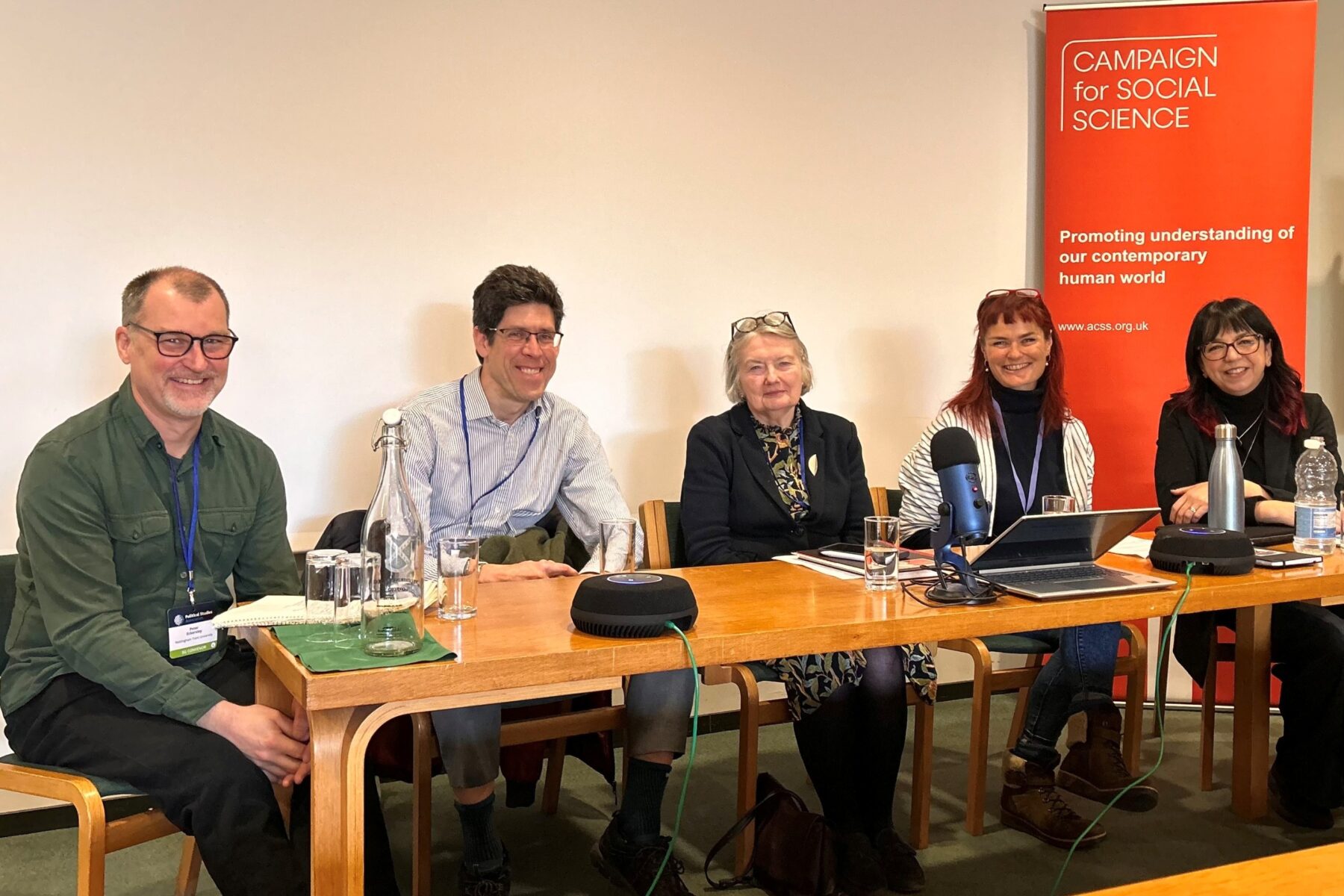
As part of the Campaign for Social Science’s series on devolution, we were delighted to attend a roundtable session at the Political Studies Association 2026 conference held on 30 March 2026. The session was organised and chaired by Dr Peter Eckersley (Nottingham Trent University) and featured contributions from four panel members: Professor Arianna Giovannini, Professor Janice Morphet FAcSS, Dr Joanie Willett, and Dr Mark Sandford.
Below is a summary of their remarks.
Mark, who is Senior Research Analyst at the House of Commons Library, gave his perspective from his standpoint working in the UK Parliament and also as someone with expertise on the devolution of power in England and local government finance. He argued that there will come a point during this Parliament where there will be a reckoning between the current UK Government’s commitment to devolution, and Whitehall’s traditional resistance to giving power away. The 21 existing or soon-to-exist mayoral authorities fulfil a rare role in England outside of Whitehall, in that they are autonomous, strategic, policy-making bodies – but their capacity to carry out that role at scale is largely untested as yet. He argued that local government reorganisation would have been made easier if devolution to regional authorities had been completed first, and people could see the new bodies and powers and the duplication which meant the lower tier could be scrapped. Doing the processes in parallel was a bold move, but it has to be seen through now it has started. Regional devolution is where the action and the political attention is, whereas there is less focus on local government outside of the current reorganisation. But there is a sense of “cities and hinterlands” being seen as the default position for how policy gets delivered at a regional level, which is a cultural policy change from the past. Meanwhile, the obligation for all new unitary authorities to have neighbourhood committees indicates that the UK Government does not see the creation of new parish councils as the main or only option for neighbourhood governance.
Janice, who is Visiting Professor at UCL, drew on her experience in local government as a Chief Executive and in urban and rural local authorities to set out her view that the rise in devolution has not been matched by a step-change in central government thinking. We see this in areas like housing policy, where the UK Government retains power of the purse strings on areas which are nominally devolved. Integrated settlements comprise over 90 different previous budget lines, with the boards overseeing them being chaired by the Ministry of Housing, Communities and Local Government (MHCLG), meaning that control still rests with Whitehall, much like the old Government Offices for the Regions. In her view, “the dog that hasn’t barked” in the current round of regional devolution is why strategic authorities in England haven’t been more closely modelled on the template of London’s authorities which have quite integrated and well-understood power-sharing between councils and the mayor.
Janice also argued, from the perspective of someone who had taken a local authority through a reorganisation (from district to unitary), that whilst local government reorganisation is necessary for public understanding and proper democratic accountability, it has the potential to distract attention away from the important transfer of powers to regional combined authorities and mayors which will have bigger and longer-term consequences.