
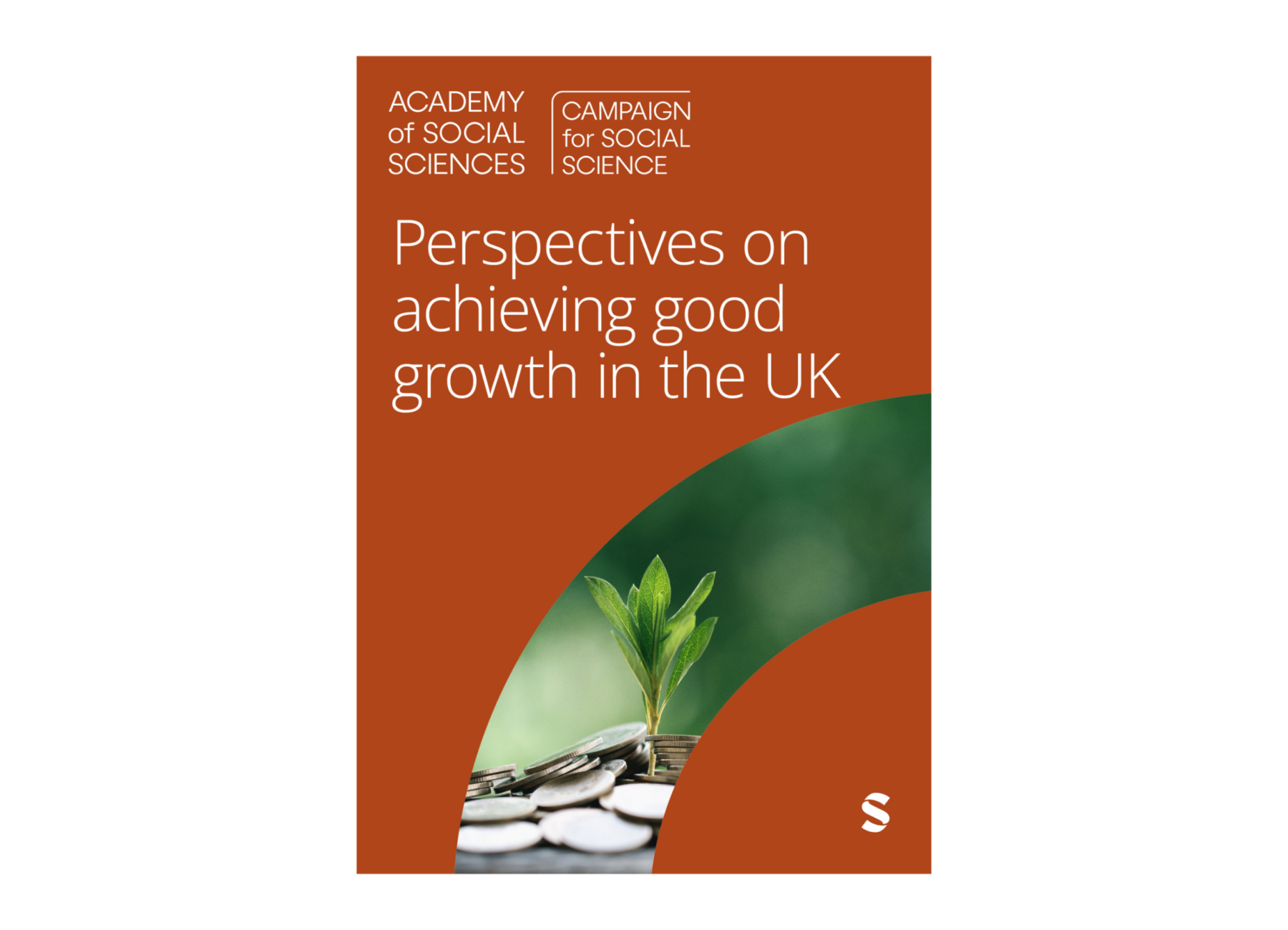
A new report by the Academy of Social Sciences showcases the breadth of social science research and insights relevant to driving economic growth and the value of multi-disciplinary evidence in informing public policy.
Following almost two decades of slow productivity growth, stagnating living standards and growing inequalities, economic growth remains one of the defining public policy challenges facing the UK Government. But the pace of growth is only one part of the challenge. And with Prime Minister Andy Burnham pledging to deliver “good growth in every postcode”, the quality, sustainability and distribution of growth are also central to ensuring that the benefits of growth are shared throughout society.
As such, the social sciences, with their understanding of economies, societal structures, behaviours, governance and place at multiple scales, have a wealth of evidence and insights to share in providing a more complete and rounded understanding of the conditions needed for growth and to point to ways it might be generated, sustained, and shared.
Perspectives on achieving good growth in the UK, which is a joint publication between the Academy’s Campaign for Social Science and Sage, draws together expert contributions from across a breadth of social science disciplines to illustrate key opportunities and challenges in the growth agenda, while also presenting just some of the evidence from across the social sciences which can help government, at all levels, make informed decisions about addressing the UK’s growth and productivity puzzle.
Specifically, the report explores perspectives, and in some cases actionable insights, from leading social scientists, including Professor Diane Coyle FAcSS, Professor Sir Paul Collier, Professor Anand Menon and Professor Anna Valero among others, across several interconnected areas: the UK’s productivity challenge, the relationship between growth and wealth inequality, the importance of place-based growth, the implications of resetting the UK’s relationship with the EU, and the wider societal conditions necessary for growth.
Although it does not advocate for a single blueprint for solving the UK’s growth and productivity challenge, the report highlights five priorities for policymakers to consider in relation to growth policy:
- Make productivity growth a long-term priority. Invest in skills, education, research, infrastructure, innovation and management capability, while supporting healthier and more inclusive workplaces.
- Pursue growth and wider prosperity together. Address wealth inequality, broaden opportunities to build assets, and ensure that economic gains translate into better living standards, housing and public services.
- Unlock the potential of every part of the UK. Use targeted investment, effective local institutions and greater devolution to support growth in cities, towns and rural areas, and narrow regional disparities.
- Combine international cooperation with domestic reform. Consider where a pragmatic UK–EU reset could reduce trade barriers and support research, innovation and investment, while addressing domestic weaknesses that constrain competitiveness and productivity.
- Build the conditions for sustained evidence-informed growth. Provide stable policy direction, effective governance and long-term investment; set clear, measurable objectives; and coordinate economic, social and environmental policies rather than treating them in isolation.
Will Hutton FAcSS, President of the Academy of Social Sciences and contributor to the report, said, “This report from the Campaign for Social Science eloquently draws together perspectives from across the social sciences to highlight the vital evidence they can provide in helping to address what is often seen as a primarily economic challenge. Yes, we must capitalise on the UK’s innovation economy and use the insights of social scientists to help drive that forward, but equally as important is ensuring society at large can support, embrace and benefit from growth across the nation. Although not a prescriptive model, the report shines a light on the huge potential that insights from all the social sciences disciplines can contribute to the growth agenda.”
Professor Jagjit Chadha OBE FGE FREcon FAcSS, Professor of Economics at the University of Cambridge, and who provided the foreword for the report, said, “Improving growth and living standards is any UK Government’s key priority and has become especially important after a prolonged period of economic stagnation and ongoing turbulent energy prices, external trading relations, and the uncertainties arising from shifting geopolitics. In the week following Chancellor Healey’s Budget and in advance of the Spending Review this report is opportune, providing a clear statement on the breadth of expertise and research evidence social sciences provide to policymakers in pursuit of growth – encompassing innovation, skills, finance, housing, infrastructure, regulation, and the quality of public institutions – for the benefit of all.”
Download the full report
For further information contact:
Amy Williams (Head of Communications) at a.williams@acss.org.uk/media@acss.org.uk
About the Academy of Social Sciences
The Academy of Social Sciences is the national academy of academics, practitioners and learned societies in the social sciences. The sector’s leading independent voice in the UK, we champion the vital role social sciences play in education, research and innovation, governments and business.
The social sciences include: anthropology; business, finance & management; criminology; development studies; economics and econometrics; economic & social history; education; human geography; law; planning; politics and international relations; regional studies; sociology; social healthcare; social policy; social psychology; social statistics & methodologies.