
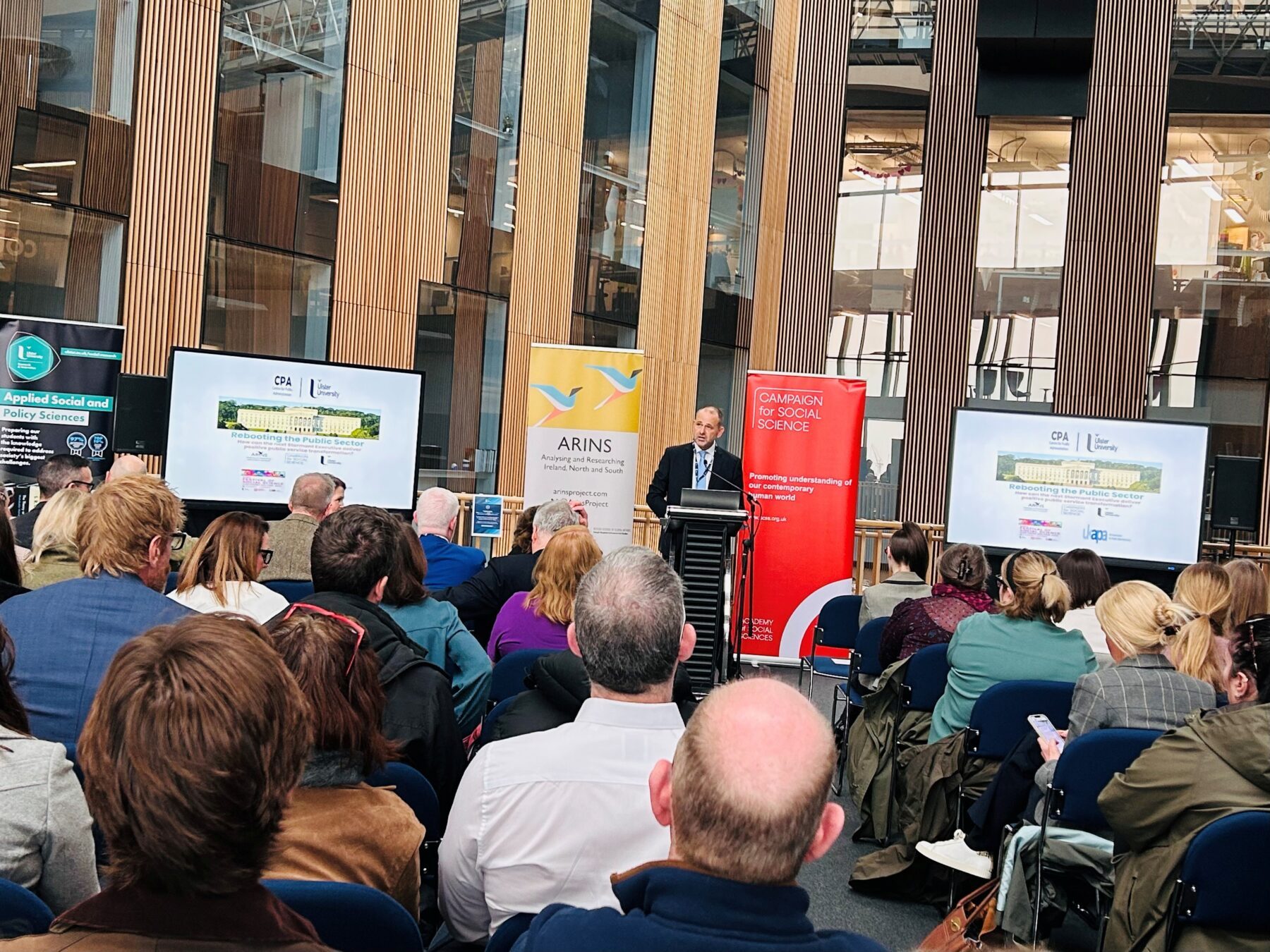
The Campaign for Social Science partnered with Ulster University, the ARINS project and UKAPA, as part of the ESRC Festival of Social Science 2026 on an event in Belfast in late October. It examined how the next Stormont Executive might create enough political and public consensus to take forward a programme of genuine, effective public service transformation which will lead to better outcomes for citizens. With so many of the choices it needs to take being painful or problematic, social scientists and practitioners asked how the case might be made and won, and what might be some of the barriers. We heard from a range of experts from across different social science disciplines about what their research and insights can teach us at this critical point in Northern Ireland’s history.
Professor Matt Flinders began the day with a keynote address on the topic “Walking on the Bright Side: introducing and understanding positive public policy”. He set out the many, complex and multi-dimensional problems facing society and the public sector – but by emphasising the need for positivity and optimism in order to help escape the ‘doom loop’ which is sometimes overly-represented by political and media narratives. Indeed, the same scepticism and pessimism is also true of much analysis by public policy academics.
Instead, Matt argued, we need greater positivity in how we examine public policy, including celebrating successes. Some of this has previously been set out in relation to England by Matt and his colleagues. Whilst the Northern Ireland context is obviously different, there are also similarities. Matt’s hypothesis was that there is a need to abandon the ‘pathology model’ of policy analysis – looking at what has gone wrong – and to instead replace it by focussing on the majority of policy work which is successful and considering how this can be expanded, replicated and developed.
One example was Sure Start – a heavily research-based policy intervention, which was contested at the time but with the benefit of hindsight is now seen to be incredibly successful. Taking those learnings, celebrating them, and using them as the basis for future policy ambition, should be more of a focus than short-term ‘blamestorming’ for policies which may appear to have failed.
Too often, public policy successes are invisible – that might be because problems never materialise due to effective preventative policy, services working as expected, or benefits accumulating quietly. Matt cited auto-enrolment of pensions as a massive success which is already taken for granted. How do we celebrate success when relatively little appears to have happened? Or even when the success is just the avoidance of failure? He highlighted the theory of ‘good enough governance’ within Development Studies, whereby ‘keeping the show on the road’ is sometimes a success in and of itself.
With that in mind, and turning to Northern Ireland, Matt sought to identify ten qualified policy successes which should be celebrated. These included – the resilience of the Good Friday Agreement, the ban on smoking in public places, the plastic bag levy, shared education, police reform of the PSNI, and cross-border health partnerships. Matt was honest and open that not every element of every policy has been successful, and that some are more symbolic than others – but by valuing those successes and making that success more visible, we might reframe the conversation and help the next Executive to approach reform differently.
Giving a response to Matt, Professor Deirdre Heenan welcomed the upbeat and positive nature of Matt’s presentation – something she argued was in short-supply in Northern Ireland. She added further context by unpicking some of the complexities within Matt’s examples. In Deidre’s view, some of those successes were despite – rather than because of – the Assembly and Executive. The choice for too long in Northern Ireland has been between bad government or no government, and it is time for that to be challenged and to change. For academics, the priority needs to be not only to highlight evidence relevant to policy, but to use it to energise debate and to emphasise the power which exists within the NI political architecture to effect change.
The programme then divided into parallel sessions on topics such as Health, Education, Housing & Infrastructure, and Law & Criminal Justice. These drew on expertise from academia (particularly from social scientists at Ulster University and Queen’s University Belfast) as well as from external practitioners on specific topics. These included Dr Anthony Harbinson (former Permanent Secretary for Northern Ireland) and Drew Harris (former Deputy Chief Constable of the PSNI). Each panel sought to explore what ‘good’ might look like in terms of reform, and what might be the areas of consensus from relevant current social science research which could inform future change (how politically acceptable they might be). Panels also examined what lessons might Northern Ireland learn from other parts of the UK or from the Republic – and equally, what they might usefully learn from NI.
Then, in our final panel of the day, we asked voices from beyond academia to respond to some of what they’d heard, and consider the wider political context around the topics analysed by our academic and practitioner experts.
Professor Ann-Marie Gray FAcSS talked about how Northern Ireland’s policy successes have often been incremental, and therefore easy to overlook. In her view, the policymaking process has too often underestimated the public’s appreciation that the change required is complicated, nuanced and difficult. Frances Ruane from the Economic & Social Research Institute said she had been impressed (today and previously) by the willingness of academics to engage with government. And for their part, government want to use evidence – but they need pushing and helping along the way. From the other side of the divide, Patrick Gallagher, Head of the Delivery Unit in the NI Executive Office, was honest about the limitations of government, both in terms of funding and political consensus. He cited preventative healthcare as an area where funding is limited, not least because of political pressure to spend on the here-and-now. Finally, Ann Watt from the independent thinktank, Pivotal praised the day’s focus on positivity, and that this is a challenge Northern Ireland’s policymakers need to rise to. She also spoke also about the aversion of the political class towards laying out a positive vision – including on some of the topics which have been discussed today. The panel was chaired by Mark Hennessy of the Irish Times, who probed in particular on the topic of arms-length bodies, of which Northern Ireland has a disproportionately large number compared to other parts of the UK, accounting for 77% of spending by NI departments.
Key takeaways from the day included:
- There was a warm welcome for Matt’s keynote from the largely Northern Ireland based audience, because of a recognition that there have been notable policy successes since the 1999 Good Friday Agreement and the establishment of the Assembly. But this was coupled with a scepticism about whether the institutions which oversaw some of those policy successes was fit to deliver the next round of reform which is desperately needed.
- Across the parallel sessions, this was unpacked in greater detail, with panellists laying bare the nature and scale of challenges to reform of specific public services (notably Health and Education). That said, there was also a consensus that where there was a concerted effort to focus on specific problems (eg, violence against women & girls) where Northern Ireland fares especially badly, progress can be made – particularly because there is often a political consensus behind the need to act.
- The final panel were clear that they felt there has been a risk-aversion within NI policymaking (within and outside government) over recent decades, avoiding difficult conversations about public services. An honesty about that, and a willingness to start engaging with the public on topics such as hospital closures or schools reform, would be a good starting point for what happens next, and for the politicians to lead public opinion rather than follow it.
Watch the keynote address from Professor Matt Flinders below: