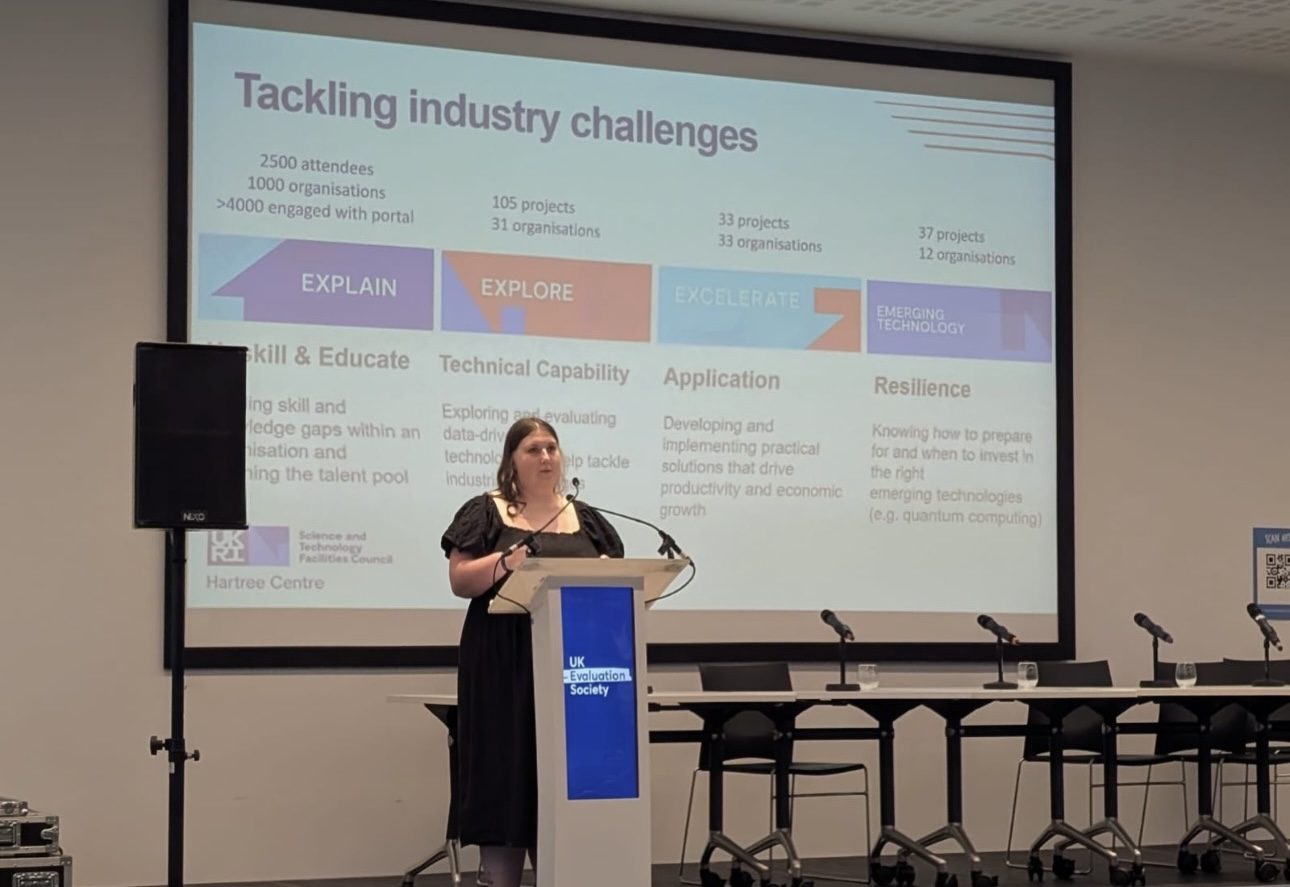
Megan Lawson is an Impact Evidence and Evaluation Manager at the Hartree Centre, which is part of the Science and Technology Facilities Council. In her role she leads impact and evaluation work which uses and tests social science methods to understand what digital technology can deliver for society. Specifically, Megan focuses on generating evidence that informs policy, improves programme design and strengthens accountability across the research and innovation funding landscape.
Role: Impact Evidence and Evaluation Manager
Organisation:Hartree Centre, the Science and Technology Facilities Council
Sector: Public
Studied: Social Science Research (MSc), Economic and Social History (PhD)
Megan Lawson
How did you get to where you are now?
I’ve always had a desire to uncover untold stories and peel back layers of meaning, which probably started from taking psychology at A Level. At university, I studied Modern and Contemporary History before progressing to a History Masters where I specialised in the study of workhouses and poverty in local settings. From here I completed a Masters in Social Science Research and then my PhD in Economic and Social History where I examined the history and lifecycle of vagrants. This taught me how to analyse human behaviour and social systems, which naturally led me into impact-focused roles. That deep dive into overlooked and marginalised stories and structures was a springboard that I still call on today in my day-to-day work.
What do you do in your current role?
I analyse the impact of the science portfolio at the Hartree Centre, which is part of the Science and Technology Facilities Council, to understand the effect of investing in AI, high performance computing and digital skills. I set the direction, strategic opportunities and reporting mechanisms for multimillion pound investments, as such a lot of my time is spent turning complex science into clear and understandable impacts on society to help shape future investments in research.
“Social science gives you a way of understanding people and systems that’s so valuable in almost any career.”
What skills do you need for this role?
In my role I am consistently using strong analytical skills, as well as the ability to interpret both qualitative and quantitative data. I also rely heavily on relationship-building and understanding how people and systems interact, and so clear communication is also essential for me to do my job effectively.
What do you enjoy most about your job?
I love uncovering a story and relating the science to a real-world problem. Seeing an AI model deployed into the NHS and genuinely saving lives, predicting drug performance and discovering more treatments is a particular highlight for me. From my position, I get to see the full cycle of research and get to become a mini expert in hundreds of topics a world away from my academic background. I’m constantly learning and no two days are the same!
What impact does your role have?
My work helps organisations and UK Research and Innovation (UKRI), which is the national funding agency investing in science and research in the UK, to understand the real-world effects of their investments and make evidence-based decisions about research and innovation programmes. Ultimately, it ensures that the support we offer genuinely meets people’s needs.
“Social science gave me the tools to explore questions about why people act and how society shapes their choices in a rigorous and meaningful way.”
Why did you choose to study social science?
I’ve always been inspired and drawn to understanding people. I had a natural curiosity to find out more and dig into facts and figures. I like to delve into stories and bring life to words on a page. Social science gave me the tools to explore questions about why people act and how society shapes their choices in a rigorous and meaningful way.
Where do you see yourself in five years’ time?
I see myself working to shape policy for the UK, ideally in a role where I can shape strategy and build capability for public good. There’s a lot of scope to move into leadership, policy influence, or specialist evaluation roles. Impact evaluation and analysis is a great cross-cutting career to absorb a multitude of skills.
What would you say to someone considering studying or pursuing a career in the social sciences?
Do it – social science gives you a way of understanding people and systems that’s so valuable in almost any career. It teaches you to think critically, analyse deeply, and sew together the fragmented pieces of an experiential mosaic that employers really value.

This interview was undertaken in 2026 and was correct at the time of publication. Please note that the featured individual may no longer be in role, but the profile has been kept for career pathway and informational purposes.