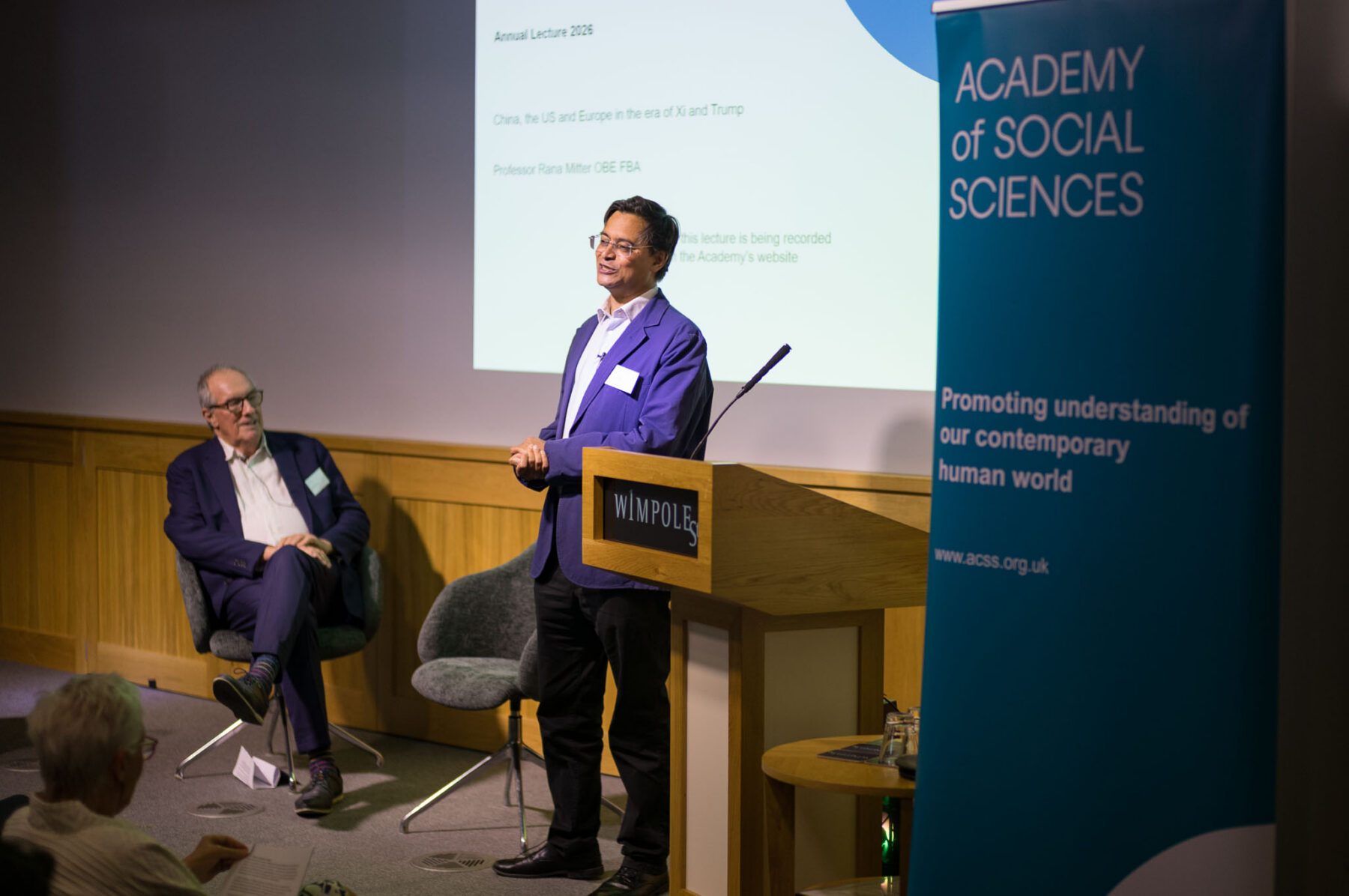
The Academy was delighted to welcome Professor Rana Mitter OBE FBA in delivering the Academy’s 2026 Annual Lecture titled, China, the US and Europe in the era of Xi and Trump.
In a wide-ranging and inspiring talk attended by Academy Fellows, invited guests and members of the public, Rana, who is ST Lee Chair in US-Asia Relations at the Harvard Kennedy School, assessed how the world will change, and how Europe might react, in an era when the leaders of the US and China seek to change global order in new and unpredictable directions.
Rana began by stating that there is an argument that the US China relationship has been, and will continue to be, the single most consequential bilateral relationship in the world today across many fronts, including military security, culture and ideology, technology and personality. He also highlighted the nature of the fast-paced geopolitical environment in which the US China relationship is operating within and gave a rundown of key geopolitical moments over the past six months, including the ongoing Iran war.
He said, “The politics of personality have not traditionally been at the forefront of, at least some of, the areas of fruitful political science analysis where trends and wider issues have often overcome the examination of personality. […] But I think looking at these two gentlemen here, President Donald Trump, President Xi Jinping, we can see that there is a moment at which the decisions of individuals, very powerful individuals in this case, are making a significant difference in a whole variety of areas.”
Rana went on to put forward his framework of competitive anti-liberalism and highlighted two key premises for this. The first, that two global hegemons were both rejecting liberalism and were seeking a new non-liberal order, and that, as a result, this has affected many mainstream liberal ideas including the rule of law, free trade and ideas of individuals as part of civil society outside of the state. He used examples of how both China and the US were using trade barriers, including tariffs, to exemplify how both countries were rejecting liberal norms, such as free trade.
He said, “This idea that you have two, not just non liberal, not even illiberal, but anti-liberal hegemons both of whom regard liberalism in the broad sense as the problem that needs to be solved, as opposed to a tool to getting to a better world, is I think pretty unprecedented, at least in the late modern era, certainly since the early 20th century.”
Rana explained that both the US and China are keen to boost growth in their respective economies and how both countries saw this as being strongly linked to technology development. He explained how this wasn’t just about AI, but also the key role China is playing in green technology and the energy transition, the rollout of 5G technology and also biotech.
He then focused in on China and shared his thoughts on what he saw as the Chinese Government’s aim in becoming the leading power in the Asia-Pacific region, and its strong interest in global influence. Rana highlighted that the largest part of that global influence thus far is economic, and that China has developed a suite of global initiatives where investment and finance is being used to develop and promote the world model which China seeks. He also touched briefly on the area of influence China holds in terms of its growing level of military power and capability for projection, with the country holding the second largest military budget in the world after the US.
He commented, “The indication of something about size can also be understood in terms of the capacity China has today that it simply couldn’t have dreamed of, and nor could the rest of the world, 20 or 30 years ago. Bluewater naval projection into the Indian Ocean and beyond, space technology, of course, very notably, and also tremendous capacity to use AI in terms of autonomous weaponry.”
Rana went on to outline some of the many core historical events that have taken place in China in the past century, including major shifts in governance and key moments such as China signing its entry to the World Trade Organisation in 2001, and used these to note how making predictions about what future relationships and governance could look like is very difficult. For instance, Rana highlighted that the WTO treaty signing was the last time that the US and China shared a geopolitical policy goal which was brought to fruition, and that since then there has been almost no geopolitical goal that both countries have shared agreement or worked together on.
He said, “With China, past performance is no guarantee of the future. […] In 1904 or 5, when the Dowager Empress Cixi was sitting behind the throne with various foreign visitors, people could see change was coming, but not many people thought 20 years hence, China would actually be a republic where the 2,000 year old imperial system had broken down and would also be a troubled country split between various war lords, all of whom were fighting each other.”
Rana then moved on to explore the defining and quite long standing elements of how China is shaping political thinking, including recent modern history from the Opium Wars of the 1830s through to the Communist Party victory in 1949; China’s economic legitimacy especially since the 1970s of increasing living standards; pre-modern thought and the Chinese Communist Party re-embracing this way of thinking and pre-modern philosophies; and, finally, the continued use of ideas from Marxism-Leninism, which are widely discussed in the Chinese Communist Party journal.
The topic of the summit held between Xi and Trump in May 2026 was something that Rana also pointed to as an example of discussions on trade relations, but also other structural issues at the heart of the US China relationship, and the China Western relationship more broadly, including the talent pool and intellectual property, and restrictions around talent mobility imposed by both countries.
As Rana commented, “These two circumstances [US restricting talent mobility into the country and China restricting talent mobility out of the country] are beginning to mean that other actors, could be the European Union, could be the emergent Global South science, not superpowers but certainly emerging powers, Malaysia, Singapore, Brazil, who may have more of a role there.”
He also touched on the diverging directions in which the US and China are approaching the energy crisis and the green economy, with the Trump administration accelerating fossil fuel use, while China is becoming the dominant player in how to balance developing their technology economies whilst not exacerbating climate change.
Rana said, “Green energy, essentially saving the planet, I think is going to be much more part of what China is looking to project to the world. […] Already the term ecological civilisation is being pushed at home as the idea of a sort of green, authoritarian social contract that is necessary to a) mitigate climate change, b) to create a more prosperous middle-class society, and c) to give a sort of moral ballast underpinning society, will also become part of the global message that China puts out there.”
Rana then discussed what a context of US China division might mean for Europe in defining itself and its role on the world stage. He pointed out that this was particularly true in terms of technology and asked whether Europe could develop its own technology environment, not just for defensive purposes but for export purposes too, in a context where actors other than the US and China exist. This brought Rana onto discussing the topic of Taiwan, which he highlighted was a contentious point between the two sides, as well how China was offering opportunities to countries including Brazil, Singapore and the UAE in science and technology initiatives.
Rana drew the lecture to an end by discussing some of his predictions in the coming years of what to look out for in terms of US, China and world relations. He suggested that the divergence on outlook on green energy for both the US and China will continue, and that, although Europe and others could hold a role in the energy transition, he believes this will be firmly directed by China. He also outlined what he felt would be a continuing divergence in terms of science research environments, with both the US and China cooperating in some areas but being protective over others and this leading to an urgency in Europe and elsewhere to have technology that is not subject to the whims of either superpower. Rana also highlighted that he believed there would be wider global influence of the Chinese ideology around welfare authoritarianism in that the collective economic good is superior to the individual liberal self.
Finally, he asked the question of whether we would see the division of the world into hemispheres of influence.
He said, “We are not looking to a clear east west division, but I think that we are clearly, at least for a while, in an environment where the United States will be spending more time thinking about its own hemisphere than perhaps has been the case in recent years. And I think China’s aim in the near future is to become the leading power in the Asia-Pacific region. So, a sort of hemispheric division by default even if it’s not necessarily a clear policy goal in either case.”
Before the Q&A session, Rana closed on a final thought, “I think it’s fair to say that the Trump Xi relationship, as it sits at the moment, is definitely in a very fluid place. It’s sometimes said that Donald Trump is the biggest China dove in his own administration and, whether or not you agree with that, it certainly provides I think a stimulating way to think about what might be different in that relationship and how Europeans and the Global South can respond, which will certainly be a very turbulent period, but one in which a whole variety of previously geopolitically impossible thoughts may come to fruition.”
You can watch the full lecture below.